Key dates
- June 30, 2026 — Program transitions from ClassWallet to the Odyssey platform. Vendor management, payments and eligibility move to Odyssey for 2026-2027.
- October 2026 — 2026-2027 family application window opens
Direct answer
To become a Missouri ESA vendor, follow the current Missouri Empowerment Scholarship Accounts (MOScholars) provider route
The current record identifies Missouri Empowerment Scholarship Accounts (MOScholars) as the state program and Odyssey as its payment surface. Complete the applicable business, professional and offering checks below, then verify the live category and transaction instructions at the official program source. A platform account or category label alone does not guarantee provider, offering or payment approval.
What is the Missouri Empowerment Scholarship Accounts (MOScholars) program?
Missouri’s Missouri Empowerment Scholarship Accounts (MOScholars) is recorded as a school-choice funding program. The current record includes the expense and provider categories below. Reported participation context: ~2,700 students, expanding toward 10,000+ with $50M in new funding. These figures show program scale, not guaranteed demand, eligibility, approval or provider revenue.
Who can be a vendor?
- Private schools
- Tutors
- Therapists
- Curriculum & resource sellers
- Educational technology vendors
How to register as an ESA vendor in Missouri
- Confirm your provider category (accredited K-12 school or a Missouri-based educational service / therapy / curriculum business).
- Onboard to the program payment platform (transitioning to Odyssey for 2026-2027) and pass vendor verification.
- Map your products / services to the MOScholars allowable-expense categories.
- Receive payment from the platform when families or EAOs purchase or approve invoices.
How you get paid
Odyssey operates program-management and marketplace surfaces for several state programs. Application, listing, fulfillment and payout mechanics are state-specific; use the current program portal for the transaction at issue.
The rail name alone does not prove whether a particular transaction uses vendor payment, a marketplace purchase, reimbursement or another program workflow. Use the option displayed in the current Missouri portal and preserve its instruction. An invoice requests payment, a receipt proves payment, and fulfillment evidence supports delivery; do not substitute them automatically.
Open the Missouri payment evidence guide for status diagnosis, fee reconciliation and the approval-to-bank record.
How long does Missouri ESA payment take?
The official source in this guide does not establish one universal end-to-end payout time for every provider transaction. Record submission, requested action, review, approval, settlement and bank match separately. If the program publishes a review window, do not present it as a bank-settlement guarantee.
What Missouri Empowerment Scholarship Accounts (MOScholars) funds can pay for
- Private school tuition & fees
- Tutoring & educational therapies
- Textbooks & curriculum
- Standardized testing & public-school classes
- Approved computer hardware
- Transportation & after-school programs
Invoicing without rejections
The current GetESAPaid Missouri record includes the fields below. Treat them as a source-backed pre-submission checklist, not a promise of approval; the live category and payment-path instruction can make a field conditional or request a different document:
- Provider (vendor) full legal name and address
- Student's full name
- Parent / account-holder name
- Invoice date and the dates of service covered
- Itemised description of each service or product
- The educational subject / purpose of each service
- Quantity / hours, unit price, and total amount due
- Provider credentials or license where the service requires one
See the sourced Missouri ESA invoice record → or build and check an itemized document (free).
Pre-submission risks to check
GetESAPaid does not yet have a sufficiently sampled state dataset to call any reason “most common.” Use the real portal message to diagnose a return. Before submission, check these document and workflow risks:
- Wrong document for the path. Confirm whether the transaction asks for an invoice, receipt, order, fulfillment evidence or a combination.
- Dates or units do not trace to the source record. Keep the service, delivery or fulfillment evidence behind each billed line.
- Description does not match the category. Identify the real service or item at the level the current instruction requests.
- Credential or authorization mismatch. Add it only where applicable, and connect it to the correct provider and period.
- Identity or arithmetic mismatch. Confirm the required recipient/account fields and calculate totals from displayed units and rates.
Records to keep for a Missouri ESA audit
Missouri Empowerment Scholarship Accounts (MOScholars) vendors can be reviewed, so keep a clean, per-student record set. Being able to produce these on request is what keeps the funds flowing:
- Business / vendor verification & tax ID for platform onboarding
- Itemised invoices mapped to approved categories
- A dated log of each service or session delivered.
Detailed operating guide
A full Missouri vendor application and operating plan
This section turns the current state record into an operating procedure. It deliberately separates facts in the official record from practical controls that a provider can use. A checklist can improve completeness, but it cannot make an ineligible provider, offering, student or transaction eligible. Read every “check” below as a prompt to compare your evidence with the current official Missouri Empowerment Scholarship Accounts (MOScholars) source, category guidance, provider agreement and in-portal instruction.
State-specific editorial dossier
What makes the Missouri provider workflow different
The analysis below is specific to the current Missouri Empowerment Scholarship Accounts (MOScholars) record. It interprets the recorded application, expense, document, timing and payment facts without turning them into approval or payout promises.
Missouri’s 2026 platform transition is the central operating fact
The MOScholars record describes a move from ClassWallet to Odyssey for the 2026–2027 cycle. Providers need a cutover plan, not a blended set of screenshots and assumptions. Identify which platform owns each school year and open transaction, preserve legacy references, complete Odyssey verification, and avoid submitting the same request to both systems. Customer and staff instructions should state the applicable year and platform. A prior ClassWallet account or payment does not prove Odyssey onboarding, and a new Odyssey profile should not erase the historical evidence needed to reconcile earlier transactions.
Missouri provider eligibility begins with location and category
The record distinguishes accredited K–12 schools and Missouri-based educational service, therapy or curriculum businesses. Confirm that the legal entity and operating facts support the selected category before onboarding. Keep vendor verification and tax identification with the platform decision, but protect those files from unnecessary access. Map products and services to the current MOScholars allowable expenses only after describing what is actually provided. The program’s expansion and new funding describe potential scale; they do not guarantee approval, student demand or provider revenue.
Missouri invoice mapping is especially important during migration
The captured documentation includes business or vendor verification, tax ID for onboarding and itemized invoices mapped to approved categories. Give each invoice a stable identifier that survives the platform change. Record the program year, platform, provider account, real service or product, dates or quantity, price, category and supporting delivery evidence. Tuition, tutoring, therapy, curriculum, testing, public-school classes, computer hardware, transportation and after-school programs should not be combined into a single broad line. Check current limits and route instructions in the official source.
Missouri reconciliation must prevent duplicates across platforms
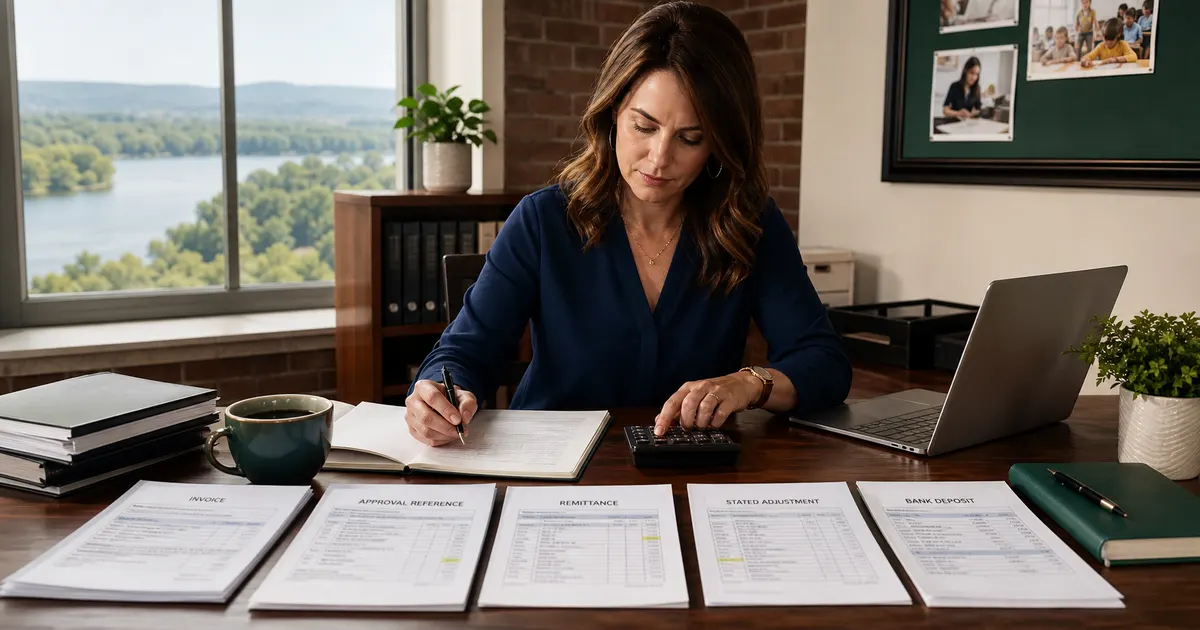
The June 30 transition and October 2026 family window can create overlapping preparation and payment records. Build a migration ledger showing draft, submitted, returned, approved, settled and unmatched items on each platform. Before resubmitting anything in Odyssey, determine whether ClassWallet already holds or approved the transaction and follow the authorized transition instruction. Preserve the gross request, approved amount, remittance, any stated adjustment and bank deposit. Do not infer Odyssey fees or timing from another state, and do not classify every transition delay as an invoice error.
Start with six separate approval questions
A vendor application is easier to manage when “approved” is not treated as one vague condition. First ask whether the legal business can participate. Second, verify whether the person actually delivering a regulated or credential-gated service qualifies. Third, map each offering to a current expense or provider category. Fourth, check the student or account context without collecting more personal information than the workflow requires. Fifth, follow the payment path assigned to that transaction. Sixth, preserve enough evidence to explain the approved amount and eventual deposit. A green answer at one layer does not silently answer the other five.
For Missouri, the recorded program is Missouri Empowerment Scholarship Accounts (MOScholars) and the recorded payment surface is Odyssey. Those two names belong together in your internal procedure. Do not copy another state’s application, document list, fee assumption or payout timing simply because it uses the same platform. Use a folder, account label or operating checklist that includes the state and program name so staff do not submit the right document to the wrong workflow.
Work through every recorded application condition
The following conditions come from the structured Missouri record. For each one, keep three things together: the source instruction you relied on, the evidence you submitted, and the resulting status or correspondence. This creates a review trail and makes a later renewal or correction far less dependent on memory.
Application checkpoint 1: Confirm your provider category (accredited K-12 school or a Missouri-based educational service / therapy / curriculum business).
Translate this instruction into an owned task rather than pasting it into an undated checklist. Record who is responsible, which current document or portal action proves completion, when it was submitted, and whether the result applies to the business, an individual professional, or a particular offering. If the program asks for a correction, retain the earlier version and the exact request so the new submission answers the real issue instead of creating a second unexplained record.
Application checkpoint 2: Onboard to the program payment platform (transitioning to Odyssey for 2026-2027) and pass vendor verification.
Translate this instruction into an owned task rather than pasting it into an undated checklist. Record who is responsible, which current document or portal action proves completion, when it was submitted, and whether the result applies to the business, an individual professional, or a particular offering. If the program asks for a correction, retain the earlier version and the exact request so the new submission answers the real issue instead of creating a second unexplained record.
Application checkpoint 3: Map your products / services to the MOScholars allowable-expense categories.
Translate this instruction into an owned task rather than pasting it into an undated checklist. Record who is responsible, which current document or portal action proves completion, when it was submitted, and whether the result applies to the business, an individual professional, or a particular offering. If the program asks for a correction, retain the earlier version and the exact request so the new submission answers the real issue instead of creating a second unexplained record.
Application checkpoint 4: Receive payment from the platform when families or EAOs purchase or approve invoices.
Translate this instruction into an owned task rather than pasting it into an undated checklist. Record who is responsible, which current document or portal action proves completion, when it was submitted, and whether the result applies to the business, an individual professional, or a particular offering. If the program asks for a correction, retain the earlier version and the exact request so the new submission answers the real issue instead of creating a second unexplained record.
Build an offering catalogue that can survive review
Provider approval and offering approval are not always the same decision. Create a catalogue in which each service or product has a truthful public name, a plain-language educational purpose, the proposed program category, price and unit, applicable credential, delivery method, and the evidence you will retain after fulfillment. Avoid category stuffing: a broad educational purpose does not automatically turn an ordinary consumer purchase into an allowed expense.
Evaluate: Private school tuition & fees
The state record includes this category, so it is a useful research starting point. Before listing or invoicing, verify the current definition, exclusions, provider qualification, student context, price or quantity limits, authorization and required evidence. Write the offering description around what is actually delivered; do not claim the category itself proves approval.
Evaluate: Tutoring & educational therapies
The state record includes this category, so it is a useful research starting point. Before listing or invoicing, verify the current definition, exclusions, provider qualification, student context, price or quantity limits, authorization and required evidence. Write the offering description around what is actually delivered; do not claim the category itself proves approval.
Evaluate: Textbooks & curriculum
The state record includes this category, so it is a useful research starting point. Before listing or invoicing, verify the current definition, exclusions, provider qualification, student context, price or quantity limits, authorization and required evidence. Write the offering description around what is actually delivered; do not claim the category itself proves approval.
Evaluate: Standardized testing & public-school classes
The state record includes this category, so it is a useful research starting point. Before listing or invoicing, verify the current definition, exclusions, provider qualification, student context, price or quantity limits, authorization and required evidence. Write the offering description around what is actually delivered; do not claim the category itself proves approval.
Evaluate: Approved computer hardware
The state record includes this category, so it is a useful research starting point. Before listing or invoicing, verify the current definition, exclusions, provider qualification, student context, price or quantity limits, authorization and required evidence. Write the offering description around what is actually delivered; do not claim the category itself proves approval.
Evaluate: Transportation & after-school programs
The state record includes this category, so it is a useful research starting point. Before listing or invoicing, verify the current definition, exclusions, provider qualification, student context, price or quantity limits, authorization and required evidence. Write the offering description around what is actually delivered; do not claim the category itself proves approval.
Design the invoice before the first sale
Do not wait for a payment request to discover that the service log, product identifier or account information was never captured. Map every recorded invoice field to a source in the ordinary workflow. Identity fields should come from controlled business and customer records. Service dates and quantities should come from delivery logs. Product details should connect to order and fulfillment records. Prices and totals should calculate from the displayed units rather than being typed as disconnected numbers.
- 1. Provider (vendor) full legal name and address. Decide where this value originates, who verifies it, and what evidence supports it. Put the field in the template only when it applies, but do not omit a current state-required element because a national template calls it optional. Review the live transaction instruction before submission.
- 2. Student's full name. Decide where this value originates, who verifies it, and what evidence supports it. Put the field in the template only when it applies, but do not omit a current state-required element because a national template calls it optional. Review the live transaction instruction before submission.
- 3. Parent / account-holder name. Decide where this value originates, who verifies it, and what evidence supports it. Put the field in the template only when it applies, but do not omit a current state-required element because a national template calls it optional. Review the live transaction instruction before submission.
- 4. Invoice date and the dates of service covered. Decide where this value originates, who verifies it, and what evidence supports it. Put the field in the template only when it applies, but do not omit a current state-required element because a national template calls it optional. Review the live transaction instruction before submission.
- 5. Itemised description of each service or product. Decide where this value originates, who verifies it, and what evidence supports it. Put the field in the template only when it applies, but do not omit a current state-required element because a national template calls it optional. Review the live transaction instruction before submission.
- 6. The educational subject / purpose of each service. Decide where this value originates, who verifies it, and what evidence supports it. Put the field in the template only when it applies, but do not omit a current state-required element because a national template calls it optional. Review the live transaction instruction before submission.
- 7. Quantity / hours, unit price, and total amount due. Decide where this value originates, who verifies it, and what evidence supports it. Put the field in the template only when it applies, but do not omit a current state-required element because a national template calls it optional. Review the live transaction instruction before submission.
- 8. Provider credentials or license where the service requires one. Decide where this value originates, who verifies it, and what evidence supports it. Put the field in the template only when it applies, but do not omit a current state-required element because a national template calls it optional. Review the live transaction instruction before submission.
Turn Missouri dates into provider actions
A program date is not a revenue forecast. It is a planning signal that should trigger a source recheck, capacity decision or customer communication. Keep the official date beside the operational action and note when it was verified.
June 30, 2026 — Program transitions from ClassWallet to the Odyssey platform
Reopen the official guidance before this date, confirm that the event still applies, and decide whether application staffing, inventory, appointment capacity or customer communication needs to change. Vendor management, payments and eligibility move to Odyssey for 2026-2027. Preserve the source version used for the decision.
October 2026 — 2026-2027 family application window opens
Reopen the official guidance before this date, confirm that the event still applies, and decide whether application staffing, inventory, appointment capacity or customer communication needs to change. The current record does not add a separate operational note, so do not infer a funding or payment promise from the date alone. Preserve the source version used for the decision.
Three realistic vendor scenarios
A service business with several professionals
The business account may be accepted while the program still needs evidence for each person delivering a regulated or credential-gated service. Maintain a roster that connects the professional, credential or background status, effective dates, approved service category and delivered sessions. When staffing changes, verify the new professional before ESA-funded work begins. The invoice should identify the real service and period without disclosing unnecessary clinical or student information.
A seller with mixed eligible and ordinary products
Separate offerings at the catalogue and invoice level. A mixed order can be difficult to review if an allowed educational item, shipping charge, subscription, accessory and unrelated consumer item are collapsed into one line. Use distinct identifiers, descriptions, quantities and prices. Preserve the order, any approval, and fulfillment evidence. If the current workflow excludes or treats a line differently, do not hide it inside a broader educational description.
A provider serving more than one state
Create a separate rule set for Missouri even if the same staff, service and payment platform appear elsewhere. State program identity, provider review, expense definitions, credentials, authorizations, document fields, fees and settlement instructions can differ. The safest reusable asset is the underlying truthful evidence; the submission wrapper should be built for the current program rather than cloned from another state.
Source-check and revision protocol
Before relying on this page, reopen the official Missouri Empowerment Scholarship Accounts (MOScholars) source and record the date checked. Look for changes to program name, administrator, provider categories, application route, expense definitions, credentials, background requirements, invoice fields, supporting documents, transaction options, fees, deadlines and contact routes. If a handbook, portal prompt or agreement conflicts with this guide, follow the current authorized instruction and send GetESAPaid the source so the public record can be reviewed.
Keep an internal change log that states what changed, which transactions it affects, who approved the operational update and when staff or customers were notified. Do not overwrite a historical rule without preserving the version used for earlier decisions. This method supports clearer corrections and more defensible records while avoiding the false impression that any unofficial guide can guarantee approval or payment.
Six visual checks
The Missouri provider evidence chain in six visuals
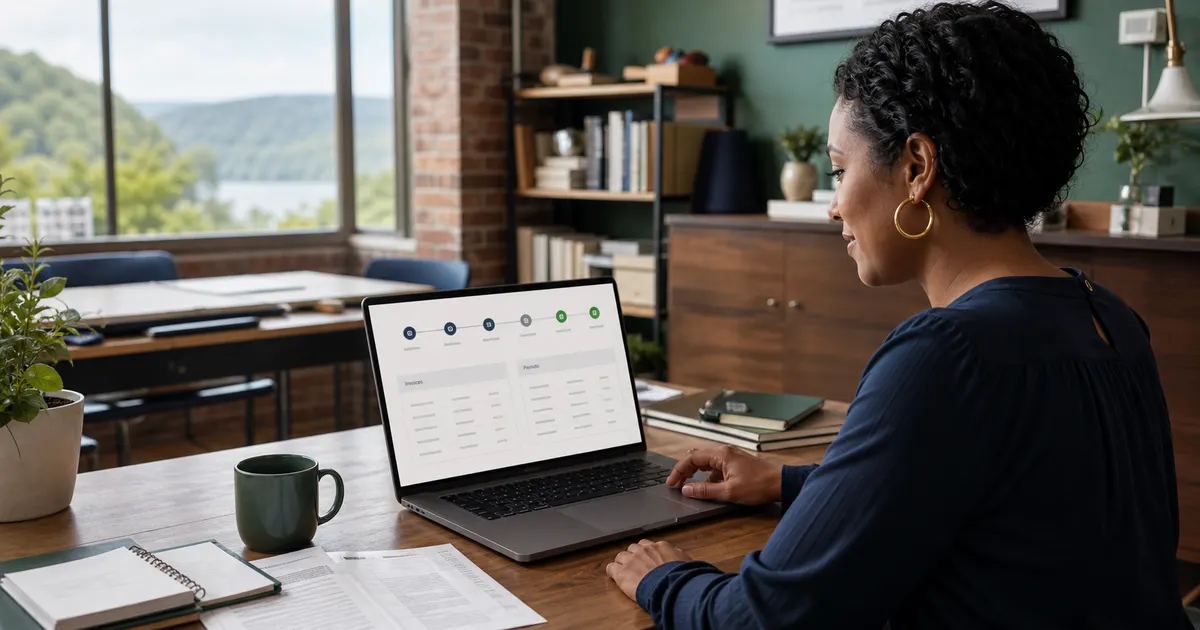
Use these as a sequence: verify the source, pass every eligibility layer, confirm the expense, assemble the packet, follow the transaction status, then match the deposit. Each visual summarizes a separate decision and the official program still controls.




Continue the Missouri research path
Connected Missouri ESA guides and tools
These pages divide the same program into distinct search questions. Use the vendor guide for approval, the invoice guide for document review, the payment guide for transaction status, and the provider guide for category-specific operations.
Missouri ESA vendor FAQ
Who can become an ESA vendor in Missouri?
The current program record names these provider surfaces: Private schools, Tutors, Therapists, Curriculum & resource sellers, Educational technology vendors. That list is a starting point; the official category, business, rendering-provider, offering and transaction requirements still control approval.
How do Missouri ESA vendors get paid?
Odyssey operates program-management and marketplace surfaces for several state programs. Application, listing, fulfillment and payout mechanics are state-specific; use the current program portal for the transaction at issue.
What do Missouri ESA invoices have to include?
The current GetESAPaid state record starts with: Provider (vendor) full legal name and address; Student's full name; Parent / account-holder name; Invoice date and the dates of service covered; Itemised description of each service or product. Verify the live category and payment-path instruction because requirements can be conditional.
What can Missouri Empowerment Scholarship Accounts (MOScholars) funds be spent on?
The program record includes Private school tuition & fees, Tutoring & educational therapies, Textbooks & curriculum, Standardized testing & public-school classes, Approved computer hardware, Transportation & after-school programs. A category name does not automatically approve a provider, item, service, student or transaction.
Sources
- Official Missouri Empowerment Scholarship Accounts (MOScholars) program: https://treasurer.mo.gov/MOScholars/
- Payment platform: how Odyssey pays vendors →
Rules last verified July 2026 against the official program sources above. Rules change — verify against the current program handbook before submitting.